|
|
|
|
|
Performer
Biographies
Maza
Meze web site
Maza Meze
brochure (PDF)
|
|
"Ancient music is dusted off with remarkable ease by this
sprawling Greco-Arabic combo" - Matt Galloway, Now Magazine,
Toronto
"Maza Meze's music was so rich that the group's Saturday
morning set felt more like a full dinner, dessert and coffee than
just a nibble or two". Georgia Straight, Vancouver
"Delightfully unorthodox Greco-Arabic belly-busters"
- Tim Perlich, Now Magazine, Toronto
"Gently bubbling, belly-dancing jams beating out of their
intriguing Greco-Arabic mix of traditional strings and percussion"
- Tim Perlich, Now Magazine, Toronto
|
|
Maza Mezé: Tasty Tidbits from the World Music Menu
If only the music people listened to was as diverse as the food
they ate---what a world it would be! Maza Mezé is devoted
to making that concept a reality. The word Mazais Arabic and the
word Mezé is Greek. They both are terms that describe the
assortment of appetizers served at the beginning of a meal in those
cultures- think babaganoush, a plate of olives, a kebabor twoIn
the eastern Mediterranean these dishes tease the palate and either
prepare the diner for more substantial fare to come or make up a
meal on their own.
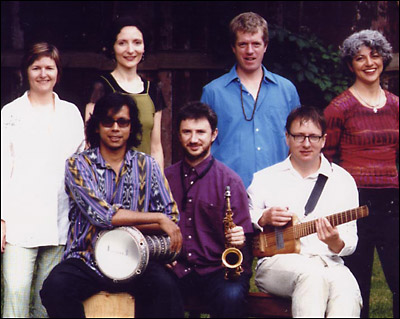
Maza Mezé is an assortment of Toronto musicians who love
the music of Greece and the Middle East. Some have been born into
the culture; others have adopted it. In 1995 they came together
to explore traditional music from the region and to create their
own original compositions based on that music. They are an eclectic
gathering of some of Torontos finest improvisers and innovators.
Vocalists Jayne Brown, Jennifer Moore, and Sophia Grigoriadis are
accompanied by instrumentalists Ernie Tollar, John Gzowski, Debashis
Sinha and Jeff Wilson as well as selected special guests ranging
from a belly dancer to a traditional Greek clarinet player. These
artists lead double if not triple or quadruple musical lives - bringing
their experience in a variety of other bands to Maza Mezé.
Their varied musical tastes and abilities allow Maza Mezé
to add many exotic flavourings from a dozen genres and traditions
to the basic Greek and Middle Eastern repertoire; a dollop of R&B
or a hint of Latin perhaps that has taken them to festivals across
Canada from Newfoundlands Sound Symposium to the North Country Fair
in Joussard, Alberta to a folk music festival in Duncan, BC. In
Toronto they have organized an ambitious year round series of concerts
that feature special guests - master musicians from as far away
as Egypt and as close as Torontos Greek community. In the process
they are transforming themselves into an institution devoted to
expanding access to superb music for audiences everywhere Maza Mezés
four cds feature infectious grooves and lush vocals, with a big
helping of melodies and a wide assortment of instruments. After
the first CD of traditional songs, Unleavened, the band went on
to make 3 more featuring original songs created by every member
of the group. Their first CD of original music, Brand New Threads,
caught the attention of CBC Records, and the band was invited to
become the first world music ensemble ever to be recorded by this
prestigious label.
The resulting CD, the Juno nominated Hypnotika, was followed by
their latest, Secrets Moon Magic, featuring guest appearances by
Trichy Sankaran, John Wyre (of Nexus fame) and autorickshaws Suba
Sankaran.
Maza Mezé's longevity and performance experience is a testament
to the great music created by this group. With fans across Canada
and around the world, Maza Mezé has become the tastiest world
music institution Canada has to offer..
|
|
Description of Instruments
|
Baglama
|
A miniature lute |
|
Bansuri
|
Indian bamboo flute with 6 holes |
|
Def
|
Middle Eastern frame drum. Often used alone to accompany singing,
particularly Sufi music. It is made with a traditional goat
skin or fish skin head on a hardwood shell. |
|
Dumbek
|
Arabic drum with hourglass design that produces a high resonance
and a deep Doum. It has a large neck inside and out for maximum
strength. The head can be made of plastic, fiberskyn, goatskin
or fish skin. |
|
Fretless
Electric Guitar
|
Made by John Gzowski to accommodate the microtones in Arabic
and Greek maqams (scales). |
|
Ney
|
Long end-blown cane flute of the Near East, used from Egypt
to Persia. The sound is produced by blowing across the sharp
edge with pursed lips. |
|
Oud
|
The oud, predecessor to the European lute, is the ancient and
modern lute of the Near East, known from the 7th century. The
modern oud has a shorter neck than the European lute. The oud
usually has 3 soundholes and no frets. Popular throughout the
Middle East, Turkey & Greece. |
|
Qanun
|
The qanun is an ancient Asian table harp. The index fin- gers,
clad in picks, pluck the strings in groups of three. In the
twentieth century, the Turks improved the design by adding tuning
keys to alter the pitch of individual strings by eighth or quarter
tones, thus facilitating transposition. |
|
Riqq
|
Middle Eastern tambourine that has a fish skin or plastic
head and brass jingles. Tamboura A Balkan stringed instrument
in the long-necked lute family. |
|
Zils
|
Finger cymbals.
|
Repertoire Summary
Maza Mezé’s repertoire falls
generally into three categories:
1. GREEK REPERTOIRE:
Maza Mezé performs songs that belong to a tradition
originating in the Greek communities of Asia Minor, primarily
around the centres of Smyrna and Constantinople (known today
as Izmir, Istanbul, and Turkey). The instrumentation, (usually
violin, oud, qanun and dumbek), modes, rhythms and vocal style
are most closely related to Arabic music, given the historic
Islamic influence in that area.
Maza Mezé also performs a variety of Greek folk songs,
from improvisational ‘table songs’ to traditional dance music.
These folk songs originate in northern Greece, and are characterized
by irregular meters of 7/8 and 9/8.
Maza Mezé continues to develop its understanding of this
music through old recordings, and by working with the songs
in the same spirit of improvisation that accompanied their
creation.
2. ARABIC REPERTOIRE:
Maza Mezé studies and performs a mix of classical folk
and popular music from Egypt and Syria. The instrumentation
is based on the qanun, percussion, and often strings and horns.
Using the musical resources at hand, Maza Mezé forms its own
interpretation of songs using instruments and improvisations
that complement the tradition. In 2001 four members of Maza
Mezé studied performance and theory of this music in Cairo,
Egypt.
Saidi music is hypnotic, joyful music from the
Upper Nile region. Here, Maza Mezé brings in contemporary
instruments to create organic traditional sounds (ie. we replace
the synthesizer so often used in authentic recordings!)
Other songs derive from the Mowashahat tradition (a tradition
that flourished during the twelfth and thirteenth centuries
in Andalusia, setting Arabic devotional poetry to music using
complex rhythms and modes.) This music has continued through
modern compositions in this style, primarily in Aleppo, Syria.
Two of Maza Meze’s members have studied this form extensively
both in Toronto and in Syria in 1996.
3. ORIGINAL COMPOSITIONS:
With the launch of its 2nd CD in 2000, "Brand New
Threads - Songs from Middle Eastern Canada", Maza Mezé
solidified its path in the direction of more original compositions.
"Brand New Threads", and our latest CD "Hypnotika"
(recorded and produced by CBC Records, launched Oct 1, 2002)
contain original pieces by all band members. The pieces are
written in many musical dialects, but share the band’s common
fascination and love for the music of the East.
We would be pleased to offer a complete list of songs from
each category.
|
|
|